

Father Anton Harapi, without a grave in Albanian land!
Father Anton Harapi, on the anniversary of his birth, ...


Students in Serbia and SPAK in Albania, in the absence of self-correcting mechanisms of democracy, have turned into challengers of the movement-state system
1.
Two years ago, the lek and the Serbian dinar were matched to have the same value. This made it easier to calculate the costs for Serbian tourists who were welcomed in Albania and had good words about the hospitality, and some would even express themselves well about the quiet and safe transit route through Kosovo to go and back.
The leaders of the two countries expressed great public closeness and co-led the "Open Balkan" project. This closeness in some environments in Kosovo was seen with a critical eye, from a slight mistrust to conspiracy theories, fueled in no small part by the coordination of the two leaders with the former Prime Minister Thaçi in the project of the territorial division of Kosovo.
Over the years, speculations about the closeness of the two countries, namely, of their two leaders, would grow. Both leaders would use the same Israeli team that conducted frequent fortnightly polls and prepared their parties' election campaign for the elections. Both leaders would open the doors to large construction projects - Belgrade on the Water, Durrës Marina - for investors from the United Arab Emirates, who as an investment brought the name and sketch-project and who, as a rule, expected the investment money to be given by investors (usually insiders) whose name could remain guaranteed anonymity.
A perception of closeness conveyed Prime Minister Rama's consistent interventions in Kosovo's internal affairs - not consulted with Kosovo's leadership and contrary to Kosovo's interests - with the creation of the impression of a new "brotherhood" between Tirana and Belgrade. For conspiracists, it was a quick introduction to the creation of historical analogies, from the time of Serbian Prime Minister Pashiq for the exit of Serbia to the port of Durrës or the actions of the Communist Party of Yugoslavia in the creation of that of Albania.
2.
The lek went its own way of strengthening after the decision of the head of the country that the money entering Albania does not require proof of origin nor the obligation to circulate through the banking system. The dinar, meanwhile, maintained stability and respect, while the average salary of the country's citizens doubled thanks to foreign investments in the country's industry.
Like the lek and the dinar, both countries are different and so are their leaders. Albania is a country without problems with its neighbors, it has started EU membership negotiations and there is predictable and high growth in tourism (and construction). Serbia is a country with open identity problems with at least three neighbors, a country that has opened the EU membership negotiation process and has recorded an impressive economic growth based on the preservation and development of its industrial base and foreign investments. Prime Minister Rama is a charming figure and feels at home in gatherings of Western leaders; President Vu?i? has managed to be respected by the main Western leaders and equally by Presidents Putin and Xi Jinping in the conditions of a world geopolitical mess.
And yet, despite the differences in geopolitical orientation and intellectual affinity, the two leaders share together a challenge that can be great both for them personally and for their countries. Prime Minister Rama and President Vu?i? are at the head of political movements that have surpassed the form of competition between political parties. Purple, with which the painter and Prime Minister Rama colored the Socialist Party with the successful fusion of the colors pink (of the socialists) and blue (of the democrats) which was the most eloquent form to show that this party no longer had ideological boundaries - it would be a movement "popular".
President Vu?i? has ritualistically repeated that the People's Party of Serbia is an "umbrella party", under which all ideologies, thoughts and social strata come. The Socialist Party of Albania is at the same time the vanguard of the pensioners who still believe they are in the Labor Party, of the middle class citizens, of young professionals looking for state jobs, of the millionaires and "strongmen" of Shkodra and Elbasan; Vucic's SNS had both gay prime ministers and a large homophobic membership.
3.
This year, the legitimacy of both leading movements of the two countries can be contested. This contestation will not take place with elections, there are different forms of manifestation in both countries and there is no easily predictable result.
Serbia has entered 2025 with the protest against the government of an organic movement of students and pupils, supported by many other sectors of society, from farmers, trade unionists and theater artists. The initial cause of the protest was the tragedy of 15 people killed in the collapse of part of the railway station building in Novi Sad - a building renovated by a Chinese company with an initially secret contract - but it soon took on the dimension of confrontation between society and the system. When President Vu?i? started giving explanations and asking for dialogue with the students, their answer was very simple - "he is not competent".
In the constitutional system of Serbia, the powers of the country's president are clearly defined. The citizens of the country, meanwhile, see almost every day the appearance of the country's president who explains which villages were connected with asphalt yesterday, how much their pensions are expected to increase in the first quarter of the year, how many potatoes and beans are in the state's reserves, how many tanks does the Serbian army have and how many pieces of artillery will it produce to fill the army's reserves, how many pieces of tires does the Chinese factory Linglong in Serbia produce and how much was the production of electricity the day before yesterday at the power plant near Belgrade, how much gas he can enter yesterday or tomorrow from Bulgaria to Vojvodina, which opposition leader has how much in his private bank account, who said what to an ambassador at a diplomatic party... President Vu?i? is all-powerful and he does not hide this in his appearances his daily life, violating the Constitution with both feet.
Students have risen against this system which has no self-correcting mechanisms of democracy.
The party/movement in power is the one that hires, the one that controls the judiciary, the secret services, most of the media scene and so on and at the head of this movement is one person.
With a self-discipline, with collective silence of hundreds of thousands of people in the squares in the minutes of changing weather, with the capacity to gather all spheres of society, the student movement can lead Serbia to the point of democratic catharsis, where a majority will be articulated that will require the democratic transformation of the country, sometimes with free elections according to European standards.
Although it is not known when the overthrow will happen, Serbia has already entered 2025 with a new generation of democratic maturity that will seek, using a slogan of Albania from 1990, to be like the whole of Europe.
4.
Even in Albania there is no self-correcting mechanism of democracy. The description for Serbia that "the party/movement in power is the one that hires, the one that controls the judiciary, the secret services, most of the media scene and so on and at the head of this movement is one person", will add uniqueness. exotic of Albania, where the head of this movement is also the chief architect and chief urban planner at the level of the national territory and cities separately. The height of the towers in Tirana, the artistic features, the architectural studio that should do the design and many other details are determined directly by the head of the movement/state, the same one who has indisputable political authority to dismiss and appoint officials from ministers, chiefs of police, prison guards, local water utility administrators, and pretty much every public administrative function in between these positions.
Parliamentary elections in the conditions where, apart from full control of the movement/party/state, vote discipline is done with the help of criminal clans, does not indicate the possibility of a self-correcting mechanism. Albania, like Serbia, did not have an opposition with sufficient civic legitimacy to lead to transformative pressure on the streets. And unlike Serbia, an organic movement was not born in Albania that would challenge the system - the biggest movement of young people in Albania has been and continues to be by emigrating beyond the borders of the country.
Thus, in Albania, at the moment, there seems to be only one way of contesting the system, SPAK together with the follow-up court. Strangely placed in this situation (absurd even to be put in parallel with the student movement in Serbia) the work he faces is monumental: wherever the special prosecutors touch they are touching the living organism of the endemic system of corruption and organized crime. . Unlike prosecutor-society relations in democratic countries where crime and corruption are deviations from the norm, SPAK has found itself in a quagmire where crime and corruption can turn out to be the norm. SPAK is trying to prove how the former leaders of the country who are now in the opposition have sunk into corruption, warning at the same time that it is dealing with members of the current government, people close to the most powerful man in the country.
And if it reaches that point, that world will be found in the finding of the students of Serbia that is related to the very nature of the party/movement/state: if it and the undisputed leader decide more or less everything important in the country, how can it not decide on the basic mechanism of the system's operation, corruption?
5.
We do not know when and how the movements in Serbia and Albania will end; the success of neither is guaranteed.
But we already know that we have entered the year of contestation of the system, the one that, in the absence of self-correcting vote mechanisms, needs other mechanisms./ CNA

Father Anton Harapi, on the anniversary of his birth, ...
The new electoral actor in the May 11 elections appeared o...
Why is the enemy of your enemy your friend? And why is...
New Year without postcards is like spring without swal...
It's our turn! Or "It's our turn!" It doesn't really...
Hundreds of Albanians, since 2013, participated in the...
In these 34 years of transition, the Albanian political scen...
Erion Velija's statement against what the opposition l...
No one doubts the real reason for Borat's thief Lal's trip...

Millionaire mother, millionaire wife, millionaire brother,...
The situation in Albania today, in its specificity, can be...
Dear Santa, Since the end of the year is coming and y...
A few months ago I wrote an analysis entitled: "Stabil...
Today, it is December 24, 2024, and this day should be a r...
14 questions that "TikTok" asks Edi Rama 1. Is "TikTok" t...
Edi Rama has proposed to Kosovo to freeze the fruitl...
They have no scruples. They don't even have human limits. ...

Deputy Agron Shehaj took the podium in the Assembly for se...
The case of Parashqevi Simaku seems to have now passed...
1. What is the attitude that the president-elect in th...
Irfan Hysenbelliu claims to be a big businessman, an hones...
The murder of officer Enea Mekolli in the line of duty has...
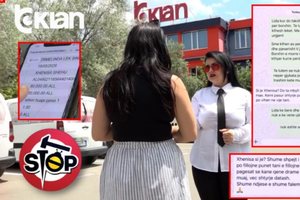
The next case broadcast on the show "Stop", this Thursday,...
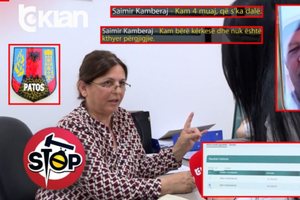
The case published this Thursday, June 4, on the show "Sto...

The Special Board of Appeal (KPA) decided this Monday ...

The KPA vetting decided this Thursday to dismiss the p...

Suela Salavaçi, a prosecutor in the Prosecutor's Offic...

The Special Board of Appeal reinstated the prosecutor ...
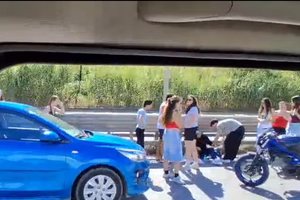
An accident occurred this Saturday morning at Shkëmbi i Ka...
A TNT explosion occurred in Lezha in the early hours of th...
A massive brawl was recorded on Friday evening in Saranda,...
A 38-year-old man was arrested today near the Kamza turnof...
Albanians are officially the hardest working people in Eur...
This Saturday will be characterized by mostly clear weathe...
Today our country will be affected by stable weather condi...

For many children and teenagers, the long summer holidays ...
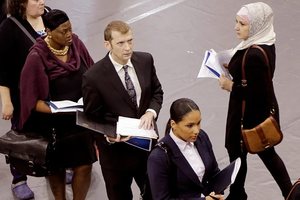
Millions of Europeans still apply for jobs without knowing...
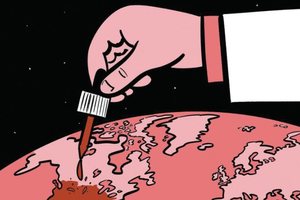
Following the Covid-19 pandemic, the World Health Organiza...
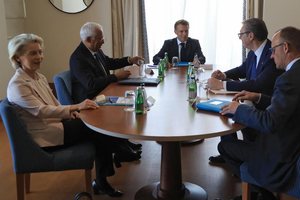
Leaders of the European Union and Western Balkan countries...
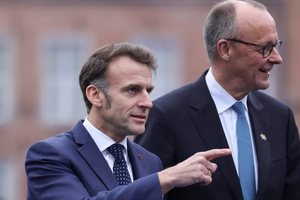
On the eve of the EU-Western Balkans summit, Germany and F...
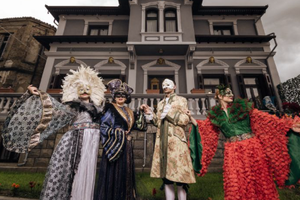
Korça is ready to open the summer season with one of the c...
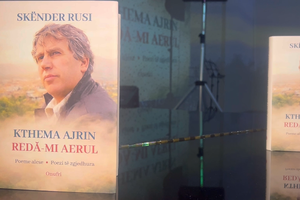
Two years after his passing, the renowned Korçë poet Skënd...
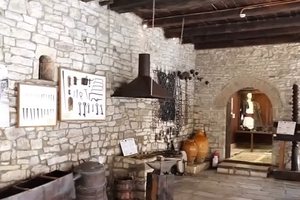
The Ethnographic Museum of Berat has opened its doors to v...
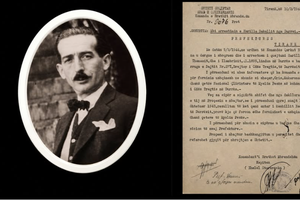
The story of Harilla Bakalli is one of the most chilling t...
This Saturday, one US dollar is bought for 81.4 lek and so...
Despite years of efforts at regional cooperation and free ...
Albania is the country with the highest level of severe ma...
This Friday, one US dollar is bought for 81.3 lek and sold...