


Territorial Reform/ Berisha warns Rama: We will get Albania back on its feet
DP leader Sali Berisha has spoken about extending the dead...

DP leader Sali Berisha has spoken about extending the dead...

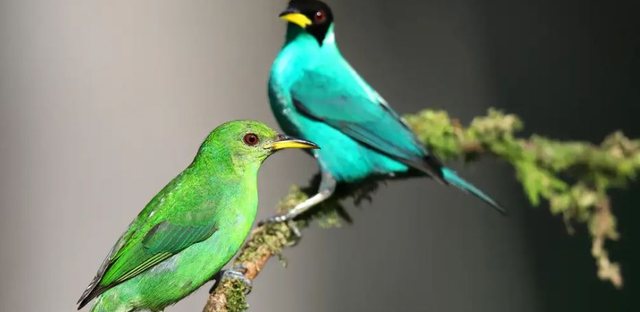
What a rare discovery! This bird (chlorophanes spiza) has the right half of the body male and the left half female.
This bird primarily feeds on fruit and is widespread from southern Mexico to southern Brazil. It reaches 13 to 14 centimeters. The male bird has green to blue feathers, the female bird has grass green feathers.
It is the first time that such a gynandromorphic bird has been observed in its natural habitat. Such gynandromorphism is created when an ovum (egg) does not divide well and is fertilized by two sperm. This rare phenomenon has also been found in canaries, crabs, butterflies and other insects.
It was observed in sandpipers 100 years ago, but until now it had not been observed in birds in the wild. And the bird 100 years ago had the colors reversed, the right was female and the left was male.
Perfect luck of the amateur ornithologist
The rare bisexual bird was discovered in Villamaria, Colombia by amateur ornithologist John Murillo. Morillo told New Zealand ornithologist Hamish Spencer, from the University of Otago, who was also in Colombia on holiday, about his discovery.
"This phenomenon is very rare in birds. Many bird watchers never come across a gynandromorphic bird in their life," explains Hamish Spencer for the scientific journal "Journal of Field Ornithology".
Fortunately, amateur ornithologist John Murillo had set up a feeder bird nursery, which the rare hermaphrodite bird regularly attended for two consecutive years. From October 2021 to June 2023, the bisected slipper appeared regularly for four to six consecutive weeks at the bird nursery, then disappeared again for about eight weeks.
A rare but rare bird
The rare bird behaved atypically at the aviary, but apparently this bisexual slipper is unusual for other birds of its species because it continues to live in isolation.
"The gynandromorph bird waited for the other shrike birds to leave the aviary, then he came in to eat. Generally he avoided the other birds of his kind, but the other birds also avoided him. Therefore it is impossible, for this individual to find a chance to reproduce."/ DW


In a year filled with extraordinary events, "The Simps...
For the first time, scientists have managed to establish c...

Duke studiuar pjesë të ADN-së së Neandertalit që mbartin e...
A European Honey Buzzard was fitted with a satellite track...
The fossilized skull of a sea monster has been excavated f...

A mystery has recently been solved by astronauts who were ...
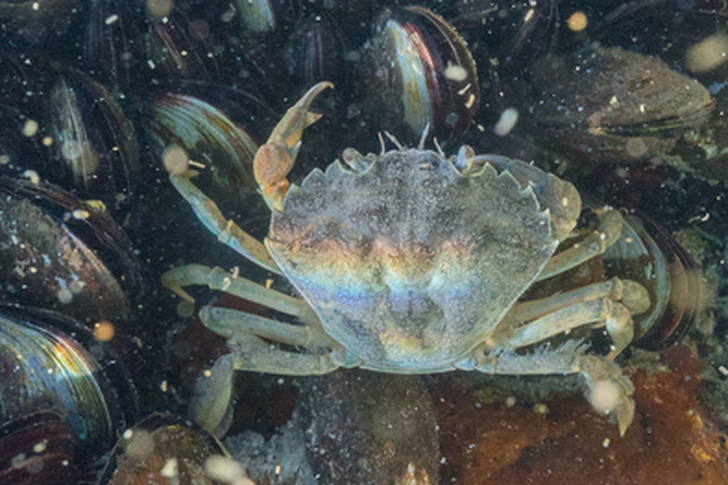
When scientists realized that about 10 billion snow crabs ...

The cars save driver data at least every two minutes. This...

Social networks have become a real tester of our emoti...

CEO Sam Altman has returned to OpenAI after hundreds o...

A bottle of whiskey described as the world's "most sou...

An extraordinary event was recorded three weeks ago after ...

At the end of last week, the new law "On private pension f...

Experiments suggest that people who are angry perform ...

There are many activities in the old town of Timisoara...

Japan's Ministry of Health and Welfare has called on the p...

Experts warn that we are reducing the shelf life of mi...

Pothuajse çdo vend në këtë botë, nga qyteti më i madh ...

A tricky math question popping up online has people scramb...

This seemingly simple question has been extensively st...

CNA has launched another investigation that could lead to ...

Irfan Hysenbelliu is a businessman that we call "Irfan the...

In March 2026, CNA launched another investigation centered...
The arrested mayor of Tirana, Erion Veliaj, with 13 charge...

The Special Board of Appeal (KPA) decided this Monday ...

The KPA vetting decided this Thursday to dismiss the p...

Suela Salavaçi, a prosecutor in the Prosecutor's Offic...

The Special Board of Appeal reinstated the prosecutor ...
Citizen MH, 61, a fisherman, was found dead near the islan...

Another phase of the international operation, codenamed "T...

Police have arrested a 34-year-old woman at Rinas Airport ...

A serious accident has occurred on the Lezhë-Shëngjin axis...

This Wednesday, our country will be under the influence of...

All of Southern Europe will face changing weather conditio...

Albania was hit by temperatures significantly higher than ...

For the first time, Pogradec welcomed the Inter-Lake Chess...

Prime Minister Andy Burnham has announced that most bus fa...

France's parliament has passed a law to ban social media f...

US Secretary of State Marco Rubio arrived in Manila on Jul...

In the space of a few days, Ukrainian President Volodymyr ...

At a time when industrial products are increasingly taking...

Trust among people is not just a three-syllable word. It c...

Master of humor Todi Llupi has passed away at the age of 7...

The ninth edition of "MIK Festival" kicked off with one of...

Businesses will no longer be required to simply register t...

Despite economic growth and income in recent years, Albani...

This Wednesday, one US dollar is bought for 81.4 lek and s...

Construction company licenses will have a validity period ...