


How has Artificial Intelligence progressed?
During the summer of 1956, a small but famous group of sch...


"The risk of underinvestment is much greater than the risk of overinvestment," said Sundar Pichai, CEO of Alphabet, which owns Google.
He, like many other leaders nowadays, was talking about Artificial Intelligence. More specifically, he was talking about building Artificial Intelligence data centers to serve the cloud technology sector. It is about large sums.
Alphabet's capital spending is expected to grow by about 5% this year, reaching $48 billion. Most of this amount will be spent on equipment related to Artificial Intelligence.
Mr. Pichai is not the only executive who has focused his efforts on Artificial Intelligence. In an earnings report on July 30, Satya Nadella, the chief executive of Microsoft, also reaffirmed plans to spend heavily on Artificial Intelligence.
Companies Alphabet and Microsoft, along with Amazon and Meta, will spend 104 billion dollars on the construction of artificial intelligence data centers this year, estimates the analytical company New Street Research.
Adding in spending by smaller tech companies and companies in other industries, the total amount of AI data centers between 2024 and 2027 could reach $1.4 trillion.
The scale of this investment and the uncertainty of whether and when it will pay off is worrying shareholders. A day after the financial results of the Alphabet company were made public, the Nasdaq technology index fell by 4%.
This was the biggest one-day drop since October 2022. Microsoft's share price also fell after the earnings release.
For now, however, the tech giants have shown no signs of slowing down investment. This is good news for the countless suppliers who are benefiting from the AI ??boom.
Nvidia, an AI chip supplier that in June became the world's most valuable company, has grabbed most of the media attention. But the AI ??supply chain is much more widespread.
It includes hundreds of firms, from Taiwanese server makers and Swiss engineering outfits to American power utilities.
Many of them have experienced a marked increase in demand since the launch of the ChatGPT app in 2022, and are themselves investing accordingly. Over time, supply bottlenecks or falling demand can leave these companies with surpluses.
Investing in Artificial Intelligence can be divided into two parts. Half goes to chipmakers, with Nvidia being the main beneficiary. The rest is spent on manufacturers of the equipment that makes the chips work, from networking equipment to cooling systems.
To assess the supply chain of Artificial Intelligence, The Economist examined a group of 60 such companies.
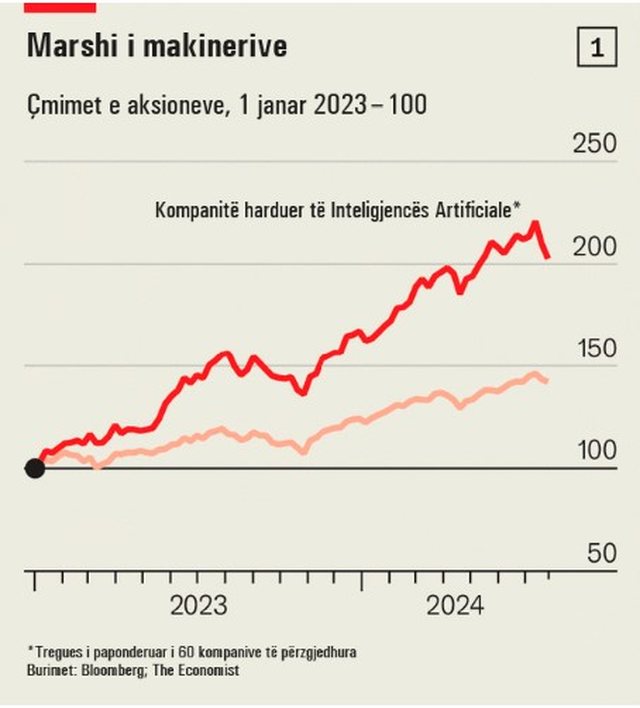
Since the beginning of 2023, the average share price of Artificial Intelligence companies has increased by 103%, compared to a 42% increase in the S&P 500 index of US stocks (see chart 1).
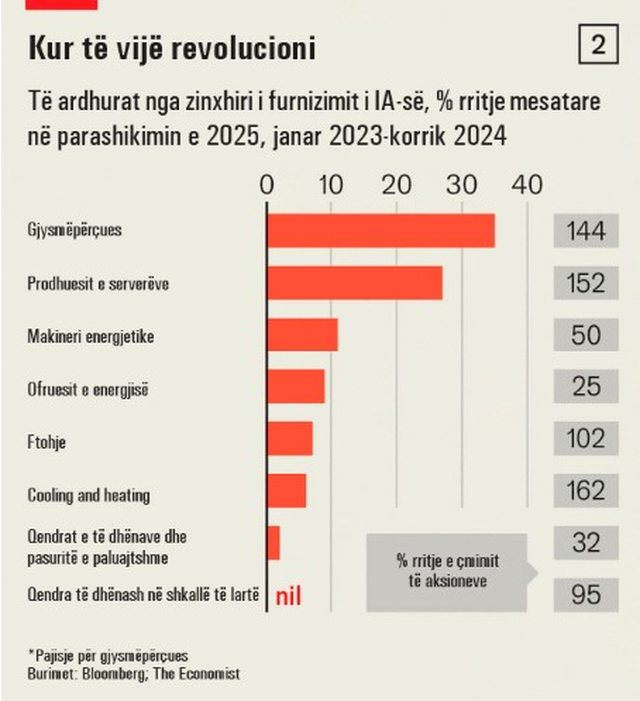
Expected sales for 2025 have increased by an average of 14%. This compares with a 1% increase for non-financial firms, excluding technology companies.
The biggest beneficiaries were chipmakers and server makers (see chart 2).
Nvidia was responsible for almost a third of the expected sales growth of the group of Artificial Intelligence companies. This year, it is expected to sell $105 billion worth of AI chips and hardware, up from $48 billion in the last fiscal year.
AMD, Nvidia's closest rival, is expected to sell about $12 billion worth of chips this year.
In June, Broadcom, another chipmaker, said its quarterly AI revenue rose 280% year over year to $3.1 billion.
The company helps customers design their own chips and also sells networking equipment. On July 25, SK Hynix, another chip maker, said it expects demand for advanced memory chips to double next year.
Companies that make servers are also making huge profits. Both Dell and Hewlett Packard Enterprise (HPE) stated in recent earnings reports that sales of Artificial Intelligence servers doubled last quarter.
Foxconn, the Taiwanese manufacturer that assembles iPhones for Apple, also has a server business. In May, the company announced that its AI sales had tripled last year.
Interest is also growing for other firms, although new sales have yet to materialize. Eaton, the industrial machinery maker, said last year that it had quadrupled customer demand in America for its Artificial Intelligence data center products.
Artificial Intelligence servers can require up to ten times more energy than conventional ones.
Earl Austin Junior, chief executive of Quanta Services, which builds renewable energy equipment, recently admitted that the growth in demand for the data center business "had been unpredictable".
Vertiv, which sells cooling systems used in data centers, noted in April that AI-related projects doubled in two months.
All this interest is fueling an investment frenzy. This year, about two-thirds of firms in the group surveyed by The Economist are expected to increase capital spending relative to sales. Many companies in the supply chain are building new factories.
They include Wiwynn, the Taiwanese server maker, Supermicro, an American company, and Lumentum, the American network cable retailer. Many companies are spending more on research and development.
Some are investing through acquisitions. This month, AMD said it would buy startup Silo AI to boost its AI capabilities. In January, HPE announced it would spend $14 billion to buy networking equipment maker Juniper Networks.
In December, the company Vertiv announced the acquisition of the firm CoolTera, which specializes in the process of liquid cooling. The company hopes that this acquisition will help it increase its production of liquid cooling technology by 45 times.
But as spending increases, so do the threats to the AI ??supply chain.
One problem is the heavy dependence on Nvidia. Baron Fung, of the research firm Dell'Oro Group, notes that when Nvidia started making a new chip every year rather than every two years, the entire supply chain had to adapt by trying to build lines of new production to meet accelerated deadlines.
Future sales for many companies in the AI ??supply chain hinge on keeping Nvidia, the world's most valuable chip maker, happy.
Another threat comes from supply barriers, especially in the availability of energy. According to a scenario from the Bernstein firm, by 2030, Artificial Intelligence tools will be as widely used as Google search is today.
This would increase electricity demand in America by 7% per year, compared to 0.2% between 2010 and 2022. It would be difficult to build that much power capacity quickly.
Stephen Byrd of the bank Morgan Stanley notes that in California, where many AI data centers can be built, it takes six to ten years to connect to the network.
Some companies are trying to fill the gaps by offering off-grid power. In March, energy company Talen Energy sold a data center attached to a nuclear power plant to Amazon for $650 million.
CoreWeave, a cloud provider, recently struck a deal with Bloom Energy, a fuel cell manufacturer, to produce energy locally. However, the needs are so great that the risk of energy shortages remains.
The biggest threat to the AI ??supply chain comes from falling demand.
In June, Goldman Sachs Bank and equity firm Sequoia published reports questioning the benefits of generative AI hardware and, as a result, the cloud computing giants' decision to spend so heavily in this area.
If AI gains remain unpredictable, these tech giants could cut back on investment, leaving their supply chain exposed.
Building factories has brought higher fixed costs. In the group of companies surveyed by The Economist, average spending on property, plant and equipment is expected to increase by 14% between 2023 and 2025.
Some investments can start to look dubious if demand is slow. The price for HPE's acquisition of Juniper Networks was two-thirds of the buyer's market value when the acquisition was announced in January.
Even after the recent swings, market expectations remain high. For the group of companies reviewed by The Economist, the average price-to-earnings ratio, a measure of how investors value earnings, has risen nine percentage points since the start of 2023.
If such expectations are to be met, AI tools must improve quickly and businesses must implement them en masse. For many companies operating in the Artificial Intelligence supply chain, the risks are growing uncomfortably./ Monitor.al

During the summer of 1956, a small but famous group of sch...

Telegram founder Pavel Durov under official investigation ...

On the hidden internet, known as the dark web, various act...

"Meta" has warned the campaigns of two candidates for pres...

AI leaders from around the world will gather for the third...

The year 2024 is already a historic year. For the firs...

The eight-day trip of two American astronauts could tu...
A company in California is producing a material that can a...

Taxi rides in the near future may be made with electric pl...
Artificial Intelligence is not just about ChatGPT, wri...
The Justice Department accused TikTok on Friday of col...

A significant part of the world faced major problems o...

Google, which has an ambitious plan against climate ch...

Images created through artificial intelligence can imi...

Bugatti has unveiled its new model, the Bugatti Tou...

Gjiganti i teknologjisë, Apple, do ta përditësojë aplikaci...

Microsoft's new Artificial Intelligence feature, calle...
President Biden's administration last month announced a $6...
Google announced on Tuesday, May 14, that it will use arti...

One of the most popular apps for short and precise videos,...

On the morning of July 7, 2026, the Ministry of Culture ur...

After the disclosure of the portfolio of properties an...

For 6 months now, CNA has been sending several letters to ...

The word "fatherland" with properties is not enough. The m...

The Special Board of Appeal (KPA) decided this Monday ...

The KPA vetting decided this Thursday to dismiss the p...

Suela Salavaçi, a prosecutor in the Prosecutor's Offic...

The Special Board of Appeal reinstated the prosecutor ...

A knife attack occurred this evening in Fushë-Krujë. Acco...

A 44-year-old man in Saranda has been seriously injured af...

Spanish police have acted on an Albanian-Spanish criminal ...

New details have been revealed regarding the murder of Egl...

Renowned doctor Shkëlqim Balili shared some important heal...

Today our country will be affected by stable weather condi...

In Albania, in 2024, 8,911 beds were available in public h...

Albania was included in the band of above-normal temperatu...

Part of Greece has been put on alert after numerous cases ...

A powerful heatwave has swept across Italy and other p...

Property owners in Europe face a range of tax obligations,...

Bhutan, Ghana and Nigeria charge visitors more for tourist...

Master of humor Todi Llupi has passed away at the age of 7...

The ninth edition of "MIK Festival" kicked off with one of...

A historic evening for Albanian culture was marked in the ...

When I turned 10, another building was built in front of o...

In addition to the effect on the decline in demand for rea...

This Tuesday, one US dollar is bought for 81.5 lek and sol...

The tax administration has announced the completion of the...
Albania has lost almost a quarter of its population since ...