


State and Nation/ Where does the difference lie and why is it important to understand?
Often used interchangeably, the concepts of “state” and “n...


When I first visited Kiev in May 2023, the Ukrainian capital was experiencing one of the largest airstrikes of the war to date: Russia launched 25 missiles and nine drones. I could hear the explosions outside my hotel room as Ukrainian air defenses shot down all the missiles. Last week, during my third visit to war-torn Ukraine, Russia set another embarrassing record by launching 30 missiles and nearly 1,000 Shahed drones in a 24-hour period (March 23-24).
The radical expansion of the scale of air strikes over the past three years is a sign that Russia’s aggressive war shows no sign of stopping. But Ukraine, though much smaller than Russia, has managed to keep pace with the aggressor. Although one drone damaged a historic church in the city of Lviv, Ukrainian air defenses last week shot down 95 percent of Shahed drones, in part using low-cost interceptor drones that are not produced by any other country.
While Russia was targeting Ukrainian homes, hospitals, and churches, Ukraine was sending long-range drones to strike Russia's oil export terminals in the Baltic Sea, more than 600 miles away.
These bold attacks have reduced Russia's oil exports by 40 percent and, consequently, reduced the oil revenues that fund Vladimir Putin's war machine.
This could partially offset the benefit Russia will derive from the war with Iran, which has brought about rising oil prices and an easing of US sanctions.
Meanwhile, Ukrainian workers have been busy repairing damage to energy infrastructure over the winter. Massive Russian missile and drone strikes had caused long power, water and heating outages, while temperatures plunged to minus 4 degrees. Everyone I spoke to in Kiev recalled it as the harshest winter ever. But spring has arrived and the power has been restored.
During my week in Ukraine, as part of a delegation from the nonprofit Renew Democracy Initiative, I experienced no power outages. (The organization has sent nearly $15 million in humanitarian aid to Ukraine, and I serve on its advisory board.) Both cities we visited, Kyiv and Kharkiv, remain vibrant and bustling, although Kharkiv is just 20 miles from the Russian border and has suffered significant damage.
During the trip, we gained some interesting insights into how this small, tenacious country has managed to create perhaps the most powerful drone army in the world. President Volodymyr Zelensky says that 30,000 to 35,000 Russian soldiers are killed or wounded every month, more than Putin recruits, and that 90 percent of casualties are caused by drones. In February, Ukraine even gained more territory than it lost for the first time since 2023, helped by the disruption of Russian forces’ access to Starlink.
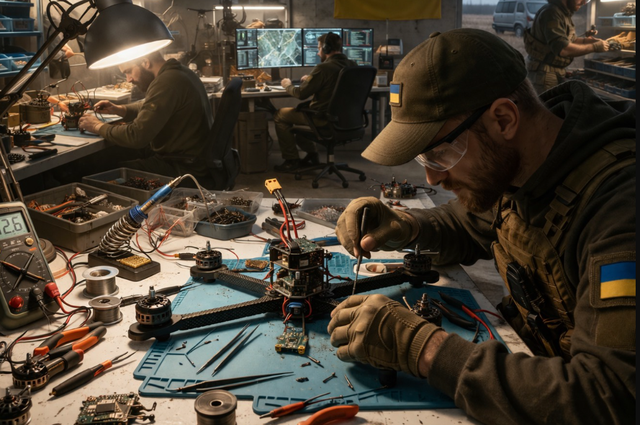
The drones that are keeping the barbarian invaders at bay, and of which Ukraine aims to produce 7 million this year, are built in factories like the one we visited in an ordinary building in Kiev that could easily be mistaken for an apartment or office. When you think of a factory, you imagine an automated production line in a large hangar. But in Ukraine, drones are built by hand, because designs change every few months, based on feedback from soldiers on the front lines. Both sides are constantly innovating in a never-ending race for advantage on the battlefield.
Workers sit on chairs designed for computer games and work at white tables to assemble the drones. Some parts (notably flight controllers, motors and fiber-optic cables) come from China, often from the same factories that make parts for Russian drones. Other parts are produced by Ukrainian subcontractors, while some are created locally with 3D printers.
The product line at this secret factory includes air defense interceptor drones that look like missiles from a Tintin comic; quadcopter kamikaze drones controlled by an operator (first-person view); and larger drones that can drop bombs or supplies. Some of them are controlled by fiber-optic cables to avoid electronic interference, while others operate via radio frequencies or Starlink internet connections.
Each drone is tested on site before being packaged and shipped. If you didn't know what was inside the pallets, you might think they were Christmas toys for Walmart or Target. But they are actually advanced instruments of war.
A few days later, I saw how these drones are used during a visit to the 429th Unmanned Systems Brigade, known as the “Achilles” Brigade. In a field near Kharkiv, soldiers demonstrated how they use a large “Vampire” aerial drone to deliver supplies or drop bombs on Russian soldiers. They also showed off an “Ardal” ground robot, a tracked platform that can transport supplies and evacuate the wounded.
Major Yurii Fedorenko, a 34-year-old former business executive, is the brigade’s charismatic commander. With his beard and an earring in his left ear, he might not fit the strict appearance standards of some American officials. But Fedorenko has been awarded Ukraine’s highest military decoration, the “Hero of Ukraine,” for his success in eliminating Russian invaders. Under the points system the Ukrainian military uses to incentivize performance, the “Achilles” brigade’s achievements are rewarded with more funding. The brigade reports hitting almost 38,000 targets last year and aims to hit 80,000 this year.
Fedorenko was just one of many impressive individuals I met during this visit, others included business leaders, government officials, and civic activists. Their country, blessed with a well-educated population, fertile land, and abundant natural resources, will have a bright future once the war is over.
No one can say when that will happen, unfortunately. A senior Ukrainian official told me that Putin may have been close to a deal before the war with Iran broke out. But Zelensky is also profiting from the conflict in the Middle East. He is sending air defense specialists to the Persian Gulf and making deals with countries in the region that could bring a much-needed influx of capital to Ukraine’s drone industry.
Russia is also expanding its drone production and even exporting them to Iran, remaining a formidable adversary. But the Ukrainians have a not-so-secret weapon that the Russians cannot match: the determination of a democratic nation to remain free.
“After more than four years of war, most people are tired,” Roman Andreyko, CEO of the media company Lux Media, told us. “We want the war to stop. We want peace. But we are not ready to give up.” Thanks to the rapid development of the drone industry, Ukraine is not in danger of being forced to do so. / The Washington Post – Bota.al

Often used interchangeably, the concepts of “state” and “n...

The Silent Generation, the generation born between the 192...

The consumption of pork is one of the most controversial t...

From Vietnam to Afghanistan, to Iran and Ukraine. When con...

History is not always changed by big decisions or well-tho...

Julius Caesar is not just a name in the history books. He ...
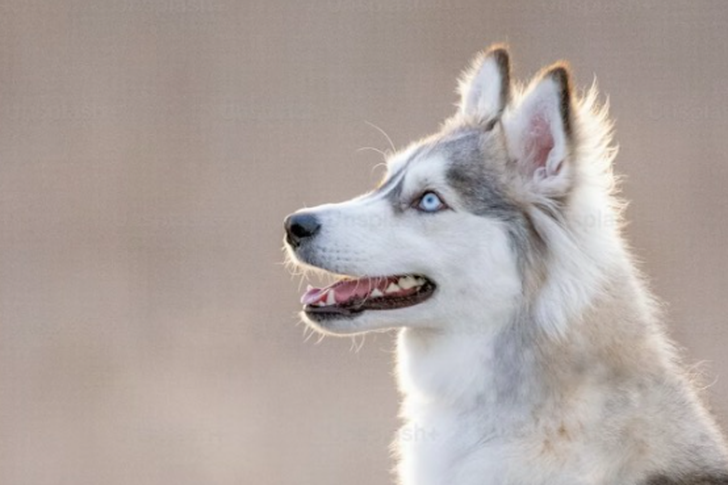
The dog is perhaps the only species on the planet that has...

Many people do not regret the mistakes they made in life, ...

Success is rarely a coincidence. In most cases, it is the ...

Depression is not just a bad day. It is not even a tempora...

In Beirut, the capital of Lebanon, an Israeli strike this ...
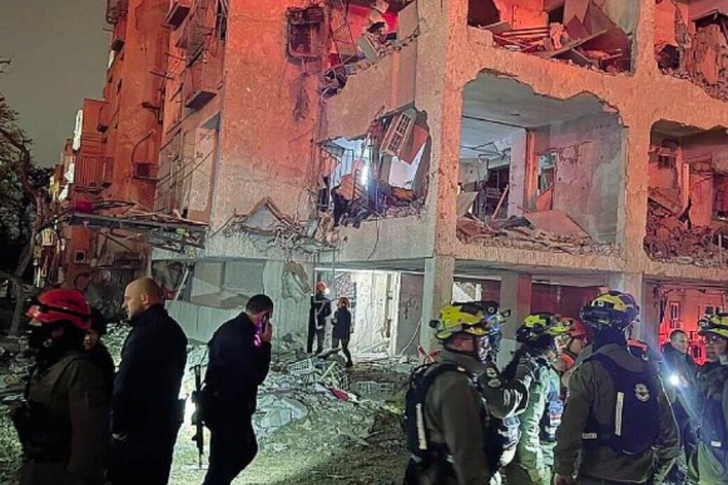
Donald Trump announces that he has "wiped Iran off the map...

On social media, what seems like the majority opinion is o...

Beyond the official history we know, there is another worl...

Amiens is a historic city with a strong cultural heritage,...

We all know the story. Helen of Troy, the face that launch...

Ayatollah Ali Khamenei, Iran's Supreme Leader since 1989, ...

In recent months, social media has been awash with videos ...

What's it like to grow up as the children of dictators? Am...

Researchers have uncovered key insights about Saturn's mys...

On the morning of July 7, 2026, the Ministry of Culture ur...

After the disclosure of the portfolio of properties an...

For 6 months now, CNA has been sending several letters to ...

The word "fatherland" with properties is not enough. The m...

The Special Board of Appeal (KPA) decided this Monday ...

The KPA vetting decided this Thursday to dismiss the p...

Suela Salavaçi, a prosecutor in the Prosecutor's Offic...

The Special Board of Appeal reinstated the prosecutor ...

A knife attack occurred this evening in Fushë-Krujë. Acco...

A 44-year-old man in Saranda has been seriously injured af...

Spanish police have acted on an Albanian-Spanish criminal ...

New details have been revealed regarding the murder of Egl...

In Albania, in 2024, 8,911 beds were available in public h...

Albania was included in the band of above-normal temperatu...

Today, our country will be affected by mainly stable weath...

Today, our country will be affected by mainly stable weath...

The death toll from two powerful earthquakes that struck V...

Oil prices rose to their highest levels in a month after t...

Iran has reacted to US President Donald Trump's statements...

Counter-terrorism police have taken control of the investi...

The ninth edition of "MIK Festival" kicked off with one of...

A historic evening for Albanian culture was marked in the ...

When I turned 10, another building was built in front of o...

A special scientific conference was held by the World Bekt...

The tax administration has announced the completion of the...
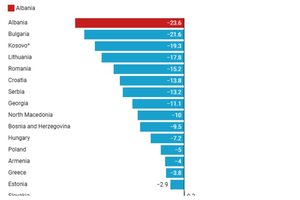
Albania has lost almost a quarter of its population since ...

This Monday, one US dollar is bought for 81.5 lek and sold...

This Sunday, one US dollar is bought for 81.5 lek and sold...